Zofia Kulik: KwieKulik | Katarzyna Kozyra | Janne Lehtinen | Paweł Książek
Opening: Saturday, 7 November, 12 - 6 pm
Exhibition: 8 Nov 2026 – 27 Feb 2027
Venue: Persons Projects, Lindenstr. 35, 10969 Berlin
Persons Projects is pleased to present Constellations of Thoughts, a group exhibition featuring four Helsinki School artists: Niina Vatanen, Jyrki Parantainen, Niko Luoma, and Mikko Sinervo, who explore the visual language of the cosmos. Using photography as a conceptual and exploratory medium, their works offer new ways to imagine and perceive the universe. Each artist transforms cosmic principles, temporal rhythms, and metaphysical questions into images that act as a visual map of thought. Exhibited together, these works reveal how we perceive, imagine, and construct personal universes, from shifting structures of time and light to speculative architectures of distant stars. The exhibition presents the cosmos through a synthesis of science, philosophy, and poetic vision.
The exhibition traces these ideas back to Zofia Kulik’s KwieKulik: The Banana and the Pomegranate (1978), a sequence of ten photographs from a performance that the artists described as "reistic theatre.” Zofia Kulik and Przemysław Kwiek sit, their heads concealed beneath metal buckets, while a curtain repeatedly opens to reveal changing arrangements of objects. Bread, bottles, mirrors, photographs, religious imagery and national symbols appear and disappear, turning the simple action into an enigmatic political theater. Created in communist Poland, the work playfully addresses censorship, surveillance and the individual’s position within an ideological system, exposing the mechanisms of political power.
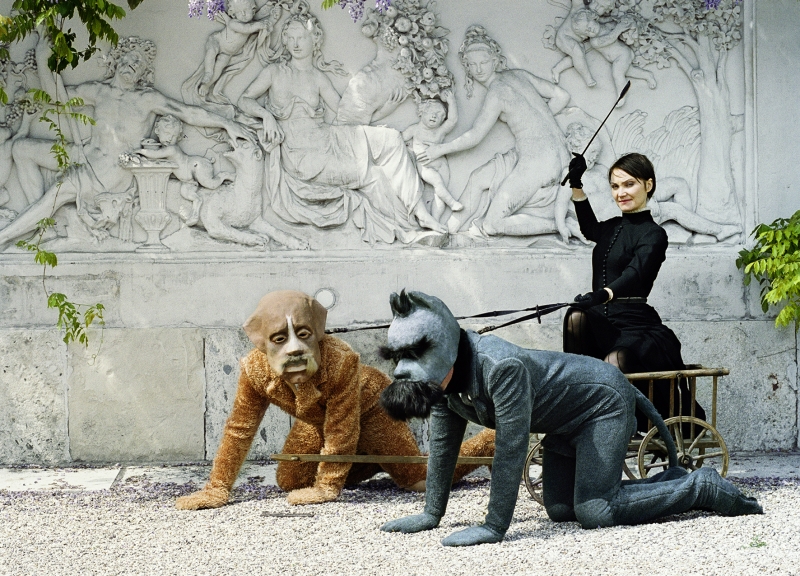
This reversal of established roles takes a theatrical form in Katarzyna Kozyra’s Lou Salomé, inspired by Liliana Cavani’s film Beyond Good and Evil. Lou Andreas-Salomé was a writer and psychoanalyst known for her independent life. In Kozyra’s interpretation, Salomé becomes a dominant figure who trains two men disguised as dogs, their masks bearing the features of Friedrich Nietzsche and Rainer Maria Rilke, both of whom played important roles in her life. Set in Vienna’s Schwarzenberg Garden, the performance transforms these celebrated figures of European intellectual history into obedient animals. Through irony and role reversal, Kozyra questions conventional relations of gender and power. Salomé, herself an important intellectual but often remembered through her relationships with famous men, becomes the one controlling the scene.
In Janne Lehtinen’s Phantoms, the act becomes quieter and more solitary. A suited figure, the artist himself, repeatedly appears before the camera, partially concealed or overwhelmed by objects and his surroundings. His actions have no conventional spectators or obvious conclusion; they exist for the photographic image. There is something paradoxical in his attempts to appear while simultaneously disappearing. His photographs carry a distinctly Finnish sense of humour, dry, understated and delivered with complete seriousness. The suited man can seem comic in one photograph and vulnerable in the next, while everyday objects become obstacles, disguises or extensions of his body. The photographs leave us uncertain whether to laugh or feel disturbed.
Paweł Książek extends these questions into painting. His ongoing N.N. vs. Artists series begins with an archive of anonymous images sourced from the internet, often depicting young people engaged in extreme or "consciousness-expanding” activities involving alcohol and sex. The boundaries between play, provocation, sadism and abuse become increasingly difficult to define. Książek brings these scenes into dialogue with performance in art, manipulating and recontextualising his sources through painting. N.N. vs. Artists asks where performance ends and spectacle begins, a question increasingly relevant in the age of social media, where private actions are staged, recorded and circulated for an anonymous audience.
This blurring of performance and reality extends far beyond social media. In the present political climate, marked by theatrical displays of power, competing versions of reality and the constant performance of identity in public and digital space, the absurd no longer seems entirely absurd. In Nothing Quite Happens, humour becomes a form of resistance, the nonsensical a critical tool, and performance a space in which established roles can momentarily be overturned.
Image: Katarzyna Kozyra, Lou Salome Palais Schwarzenberg: Carriage, archival pigment print, 90 x 125 cm, photo: Marianne Greber